Top Jamb Door Manufacturers in China for Global Buyers
For global buyers, sourcing Jamb Doors in China involves more than comparing quoted prices. Product construction, finish consistency, customization options, and communication all influence the final result. A door may look suitable in a catalog, yet small details matter: frame dimensions, hinge positions, edge treatment, and surface color must match project requirements. Details count.
This guide introduces leading Chinese jamb door manufacturers and the factors buyers can use to assess them. These include production capabilities, quality-control practices, material choices, sample procedures, and export experience. Clear drawings and written specifications help reduce misunderstandings, especially when a project includes several sizes or finishes. Ask how samples are approved and how changes are recorded. A careful answer is useful evidence, though it is not a guarantee.
Supplier claims should still be checked against project needs. Request current product data, confirm tolerances, and clarify packaging and delivery arrangements before placing an order. Where possible, compare samples under the lighting and conditions in which the doors will be used. One detail is easy to miss: different suppliers may use similar product terms for different frame designs. This overview aims to support a more informed shortlist, not replace independent checks. Buyers should weigh cost alongside fit, reliability, and after-sales communication, then decide which trade-offs make sense for their project.
Understanding Jamb Doors and Their Main Types
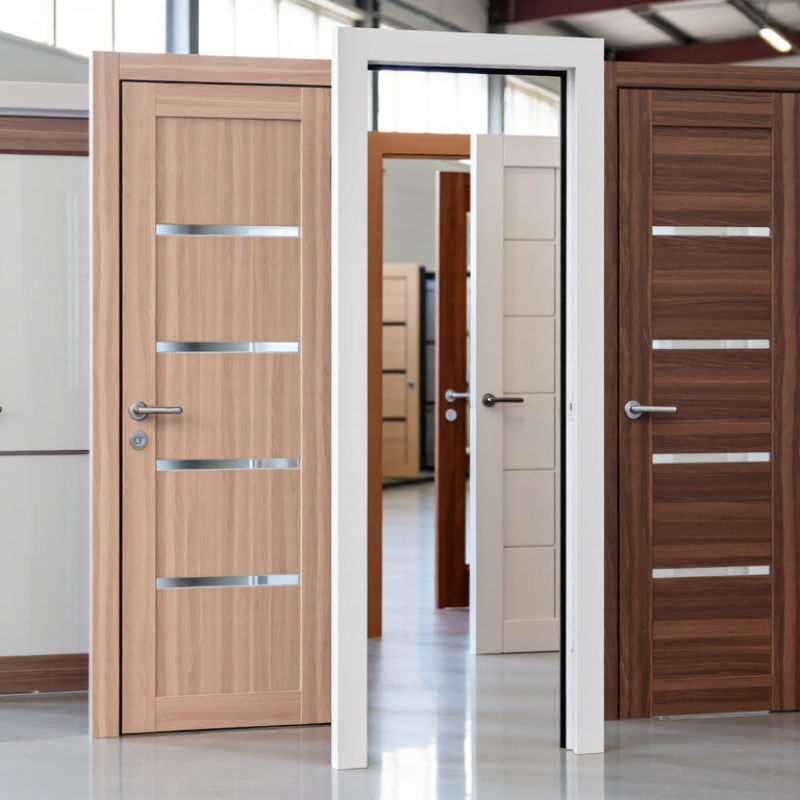
A door jamb is the frame around the door slab, including two side legs and a head. It carries the hinges and receives the latch or strike plate. Small detail. A square, rigid jamb helps the door close evenly; a twisted one can leave a wedge-shaped gap or cause the latch to miss.
Common types suit different installation needs. Prehung doors arrive with the slab already hung in its jamb, making them practical for new openings. Split jambs have two sections that meet around the wall, which can simplify fitting walls of varying thickness. Flat jambs have a simple profile and are often paired with separate casing. Adjustable jambs can accommodate some variation in wall depth, but still need accurate measurement. A common blind spot is treating the jamb as trim; it deserves a second look.
For exterior doors, the jamb must also work with weather seals and resist moisture. Check wall depth, opening size, hinge position, and threshold alignment before ordering. ENERGY STAR’s Version 7.0 residential door criteria set maximum U-factors from 0.17 to 0.23 Btu/(h·ft²·°F), depending on climate zone. That rating applies to the door product, not the jamb alone. The National Fenestration Rating Council’s labels help buyers compare rated door performance. Still, a strong rating cannot compensate for a poor installation or a loose seal.
How China’s Jamb Door Manufacturing Industry Is Organized
China’s jamb door industry is organized around a mix of integrated factories and specialist suppliers. One factory may cut and machine door leaves, frames, and jamb components, while nearby partners supply hinges, seals, finishes, or packaging. This network supports varied sizes and surface treatments. It can also make quality checks less consistent across suppliers.
The National Bureau of Statistics reported that furniture manufacturers above designated size generated 655.7 billion yuan in operating revenue in 2023, down 4.4% year on year. This figure covers the wider furniture sector, not jamb doors alone. It indicates the scale of China’s manufacturing base, but buyers should not treat it as a door-market measure.
Important distinction.
For global buyers, supplier structure matters as much as factory size. Ask who controls moisture testing, frame tolerances, coating inspection, and final packing. A supplier that coordinates component partners may offer flexibility, yet every handoff adds a point where dimensions or finishes can drift. Request production records and inspect a sample assembly, including the jamb-to-leaf gap. Small details show a lot. Some factories have strong production systems but thin export documentation; verify both before placing a large order.
Key Criteria for Evaluating Chinese Jamb Door Manufacturers
When comparing Chinese jamb door manufacturers, look beyond catalog photos. Ask for a dimensioned drawing that identifies jamb depth, stop position, hinge preparation, and wall-thickness range. Request a finished sample, not just a profile offcut. Check corner joints, surface coating, and whether the door closes without rubbing. Small details matter.
Review production controls with specific questions: How are moisture content, dimensional tolerance, and coating thickness recorded? Ask to see recent inspection sheets and a batch traceability example. If testing or certificates matter in your market, verify their scope and issuing body independently. A document alone proves little.
Evaluate export readiness through packing details, lead times, and communication. Confirm how each set is labeled, corner-protected, and secured against movement in transit. Put dimensions, finish, hardware openings, acceptable tolerances, and defect remedies into the purchase specification. Then compare the supplier’s answers with the actual sample. One successful batch cannot guarantee the next. A factory visit or polished presentation is not proof of consistency. Repeat checks take effort, but they reveal more.
Profiles of Leading Jamb Door Manufacturers in China
China’s leading jamb-door suppliers usually fit three profiles: integrated wood-door plants, engineered-panel specialists, and export-oriented factories. Integrated plants make slabs, jambs, and casing in-house, which can help match finishes and machining. Engineered-panel specialists focus on stable cores and repeatable dimensions for apartment or hotel projects. Export-oriented factories may offer mixed configurations, project packing, and shipping documentation. Details matter.
China’s National Bureau of Statistics reported construction output of 31.59 trillion yuan in 2023, up 5.8%. This points to a large domestic construction base, but does not prove any individual factory’s quality. UNEP’s 2024 buildings report says buildings and construction accounted for 32% of global energy demand and 34% of energy- and process-related CO₂ emissions in 2022. That makes tight seals, durable finishes, and repairable hardware worth specifying. Efficiency claims still need test records, not just catalog language.
Buyers can request a full-size sample, then check jamb depth, hinge alignment, and reveal gaps. Ask for moisture and finish test reports, plus packing photos before shipment. A glossy sample can conceal uneven edge banding. This is easy to miss. Supplier profiles are starting points, not rankings; factory audits and project references may change the picture.
How Global Buyers Source and Import Jamb Doors from China
Global buyers sourcing jamb doors from China should begin with a clear specification, not just a product photo. List the opening size, wall thickness, handing, material, finish, and required hardware. For example, a drawing should show the jamb depth and hinge positions in millimeters. Ask suppliers to confirm tolerances and identify which components are included. Details vary.
Before placing a large order, request a sample or inspect a pre-production unit. Check how the frame fits the intended wall, whether the finish is consistent, and how the packaging protects corners during transit. Confirm production lead time, minimum order quantity, payment schedule, and shipping terms in writing. A third-party inspection can check dimensions and workmanship before dispatch. It adds cost, but may prevent a larger dispute later. Even careful plans miss something.
For importing, compare freight options and ask a customs broker to review the product description, tariff classification, and destination-country documentation requirements. These can differ by market and product construction. Confirm carton dimensions, gross weight, and pallet details before freight is booked; small errors can change shipping costs. Keep approved drawings, sample records, inspection findings, and correspondence together. One overlooked detail is easy to regret.