How to Choose Interior Door Machines for Global Buyers?
Choosing Interior Door Machines for global production is rarely a simple price comparison. The right system must match door materials, factory space, labor skills, and expected output. A solid decision begins with the door itself. Is it solid wood, MDF, veneer, or a mixed construction?
Machinery engineer David R. Miller states, “A productive machine is not the fastest one; it is the one that delivers repeatable results every shift.” This principle matters when comparing CNC routers, edge banding machines, sanding systems, drilling units, and complete door production lines. Buyers should examine spindle power, working dimensions, positioning accuracy, tool-changing speed, dust extraction, and software compatibility. Small details matter. A poorly fitted dust hood can leave fine particles across the workshop.
Global buyers also need to check voltage, control languages, installation support, spare-part access, and operator training. A machine may perform well in a showroom but struggle with local humidity, unstable power, or limited technical support. Requesting test samples is wise. Send the supplier your actual door drawings and materials. Then inspect edge quality, groove depth, surface smoothness, and cycle time.
Not every specification deserves equal attention. This is where buyers can make mistakes. A higher motor rating does not automatically create better doors. Long-term reliability, maintenance access, and service response often matter more. The best Interior Door Machines investment is practical, measurable, and suited to real production conditions, not impressive only on paper.
Define the Interior Door Machine Types and Their Main Functions
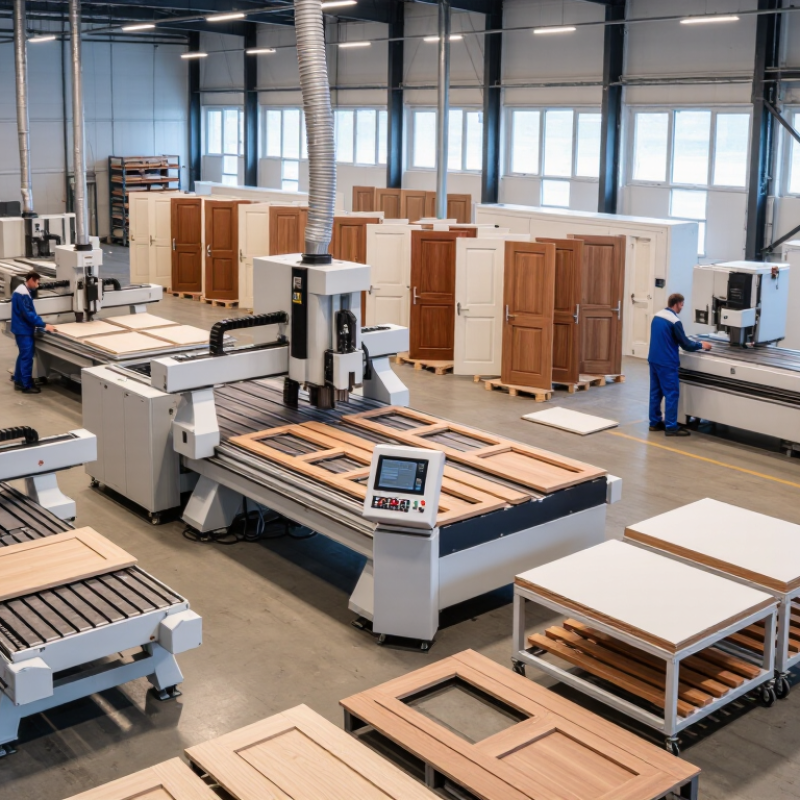
Interior door machines fall into several practical groups. Panel saws cut boards into accurate blanks, while CNC routers shape lock pockets, hinge recesses, and decorative profiles. Edge-banding machines seal exposed edges with veneer, PVC, or wood strips. Boring machines drill repeatable hinge and handle holes. Sanding units smooth surfaces before coating, and assembly presses keep frames square during bonding. Each machine solves a different production risk.
The right choice depends on door material, annual volume, and local service access. FAO’s Global Forest Products Facts and Figures 2022 reported about 3.9 billion cubic metres of global roundwood production. That scale supports steady demand for efficient wood processing. IFR’s World Robotics 2023 report recorded 553,052 industrial robot installations in 2022. Automation is expanding, but a robotic cell may be excessive for a small workshop. I have seen buyers focus on speed and overlook dust extraction, tool availability, and operator training. That mistake becomes expensive.
Tips: Map every operation from cutting to packing before requesting quotations. Check spindle power, working dimensions, positioning accuracy, and changeover time. Ask for measured cycle data, not optimistic estimates. Review safety provisions against ISO 19085 woodworking machinery requirements. Test your actual door core and surface materials before purchase. A machine that performs well on samples may struggle with warped panels, thin veneers, or seasonal humidity. Leave space for maintenance access and future automation, even if the first layout feels sufficient.
Match Machine Capabilities with Door Materials and Production Needs
Machine selection should begin with the door material, not the catalog price. Solid wood needs stable feeding, carbide tooling, and dust extraction. MDF and particleboard require clean cutting to prevent edge breakout. Veneer demands controlled pressure and accurate trimming. According to FAO’s Global Forest Products Facts and Figures 2023, global wood-based panel production reached approximately 400 million cubic metres. This scale shows why panel-processing flexibility matters for international manufacturers.
Match the machine to daily production, door dimensions, and acceptable tolerances. A CNC router suits varied designs and small batches. A dedicated profiling line performs better for repeated models and higher volumes. For laminated doors, inspect pressing pressure, temperature control, and glue-line consistency. The Freedonia Group’s 2024 World Windows and Doors report identifies replacement and renovation as important demand drivers. Buyers should therefore consider fast changeovers, not only maximum speed.
Ask for sample testing with your actual core, veneer, and hardware layout. A machine that cuts one perfect panel may struggle after eight hours. I have seen buyers underestimate dust buildup and operator training. That mistake becomes expensive. Check spindle power, feed accuracy, tooling availability, voltage compatibility, and remote service response. A perfect specification rarely survives the first trial. Build a small pilot run into the purchase decision, then revise the specification using measured defects, cycle time, and material waste.
Evaluate Automation, Precision, Capacity, and Energy Efficiency
How to Choose Interior Door Machines for Global Buyers?
Choosing an interior door machine requires more than comparing purchase prices. Automation should match your daily workflow, labor skills, and expected production volume. A fully automated line may reduce handling, but it can become inefficient when orders change frequently. For mixed door sizes, programmable feeding and quick tool adjustment are valuable. Keep it practical.
Precision directly affects fitting, finishing, and installation quality. Check cutting tolerance, drilling repeatability, and frame alignment under continuous operation. Ask suppliers for test results using materials similar to yours, including hardwood, engineered boards, and veneered panels. A smooth first sample proves little. Repeated samples matter more. Measure them.
Capacity should reflect real demand, not an impressive maximum figure. Review hourly output at your actual door dimensions and processing steps. A machine rated for high capacity may slow down because of manual loading, dust removal, or tool changes. Factory layout also matters. Leave space for safe material movement and maintenance access. Otherwise, output suffers.
Energy efficiency deserves close attention. Compare motor power, standby consumption, extraction requirements, and compressed-air use. Servo systems can improve motion control, but their value depends on workload and maintenance support. Efficient dust extraction may reduce waste while improving workplace visibility. Confirm voltage compatibility and applicable safety requirements in the destination market. I have seen buyers overlook these details. That mistake becomes expensive. Choose equipment with accessible spare parts, clear manuals, operator training, and service records. The best specification is useless when operators cannot maintain it.
Check Safety Standards, Maintenance Support, and Operator Requirements
How to Choose Interior Door Machines for Global Buyers?
Safety should be checked before cutting speed or purchase price. ISO 12100 requires machinery risk assessment, hazard reduction, and clear protective measures. For electrical systems, IEC 60204-1 addresses control panels, emergency stops, and wiring safety. The U.S. Bureau of Labor Statistics recorded about 2.6 million nonfatal workplace injuries in private industry during 2023. That figure is not door-machine specific, but it shows why guarding and training deserve serious attention.
Ask whether the supplier provides inspection records, safety circuits, and operating instructions in your language. A machine should stop when a guard opens. It should also reveal faults clearly, not leave operators guessing. Operator requirements matter too. Check loading height, panel weight, noise exposure, dust control, and training time. The International Labour Organization links effective training and safe systems of work with stronger accident prevention, yet many buyers still treat training as an afterthought.
Maintenance support can decide production stability. The U.S. Department of Energy’s Operations and Maintenance Best Practices guide recommends preventive maintenance, condition checks, and documented procedures. Request spare-parts lead times, remote diagnostics, service response targets, and a maintenance schedule. In practical evaluations, small details matter: accessible filters, labeled cables, and grease points near the floor. I have found that “easy maintenance” is often vague. Ask for photos and a real service checklist. A brilliant machine with slow support becomes an expensive lesson.
How to Choose Interior Door Machines for Global Buyers?
Priority checklist based on internationally recognized machine-safety practices, maintenance planning, and operator requirements.
The values represent practical verification points for buyer due diligence rather than market-share data. Safety checks reference ISO 12100, ISO 13849-1, and IEC 60204-1 principles; maintenance checks cover documentation, spare parts, diagnostics, and service response; operator checks cover guarding, training, setup, and personal protective equipment.
Compare Global Suppliers, Total Costs, and Export Service Terms
How to Choose Interior Door Machines for Global Buyers?
Choosing interior door machines requires more than comparing catalog prices. I begin by checking each supplier’s production experience, machine testing process, and after-sales response. Factory videos help, but live demonstrations reveal more. Watch the spindle during cutting. Listen for unusual vibration. Ask for samples using your actual door materials. A supplier should explain capacity, tolerance, maintenance intervals, and operator training clearly. Vague answers create expensive uncertainty.
Total cost includes much more than the machine price. Add tooling, export packaging, inland delivery, insurance, installation, spare parts, and local taxes. Compare quotations under the same Incoterm. Otherwise, two apparently similar offers may hide very different expenses. Confirm voltage, frequency, plug standards, and workshop requirements. A lower-priced machine can become costly after repeated adjustments. I once underestimated replacement tooling. That mistake changed the budget.
Export service terms deserve equal attention. Request a written lead time, inspection procedure, warranty period, and response timeline. Clarify who pays for damaged parts and remote troubleshooting. Ask whether manuals include clear diagrams and maintenance schedules. Reliable suppliers provide serial-number records, packing photos, and complete shipping documents. Check crate protection carefully, especially for humid sea routes. Some promises sound impressive but remain difficult to enforce. I still prefer practical evidence, even when it slows purchasing decisions.
Related Posts
-
7 Tips for Choosing Door Manufacturing Machines?
-

Maximizing After Sales Support and Maintenance Costs for Best Door Lite Cut Out Machines of Tomorrow
-

Top 10 Door Machine Manufacturers from China at the 137th Canton Fair
-
What is the Best Door Machine for 2026 Top Types?
-
10 Door Assembly Table Buying Tips for Global Buyers?
-

Unveiling the Best Door Lite Cut Out Machine A Comprehensive Comparison for Global Buyers